Walking is enough to cover the aerobic half of the federal physical activity guidelines, and after 50 that is a genuine accomplishment worth protecting. It is not enough to cover the whole guideline. The same federal recommendation that asks adults for 150 to 300 minutes of moderate activity a week also asks for muscle-strengthening activity on two or more days a week, and walking does not count toward that second part. The useful answer is not "stop walking." It is "keep every mile you are already walking, and add the half that walking was never built to cover."
Is Walking Enough Exercise? What the Federal Guidelines Ask For
The guidelines have two separate halves, and most people only ever hear about one. The Physical Activity Guidelines for Americans, 2nd edition recommend that adults get 150 to 300 minutes of moderate-intensity aerobic activity each week (or 75 to 150 minutes of vigorous activity), plus muscle-strengthening activities on 2 or more days per week that work all major muscle groups at moderate or greater intensity.
Brisk walking is moderate aerobic activity. Five 30-minute walks a week puts you at 150 minutes, which is the bottom of the aerobic range, and a daily 40-minute walk puts you near the top of it. That is the entire first half, handled.
| Half of the guideline | What it asks for | Does walking cover it? |
|---|---|---|
| Aerobic | 150 to 300 minutes of moderate activity per week, or 75 to 150 minutes of vigorous | Yes. Brisk walking counts in full. |
| Muscle-strengthening | 2 or more days per week, all major muscle groups, moderate or greater intensity | No. Walking does not count toward this. |
For adults 65 and older, the same two halves apply, with one addition: the guidelines also call for multicomponent physical activity that includes balance training. They also say plainly that adults who cannot reach 150 minutes because of a chronic condition should be as active as their abilities allow. If something about your health limits how you move, that conversation belongs with your doctor before it belongs with a workout plan.
Most Active Adults Are Half-Guideline People
The biggest gap in American activity habits is not between people who exercise and people who do not. It is inside the group that already exercises. In 2020 National Health Interview Survey data, published by the CDC in Data Brief 443, 24.2% of US adults met both guidelines, 22.7% met the aerobic guideline only, 6.8% met the muscle-strengthening guideline only, and 46.3% met neither.
Read that middle number again. Nearly as many adults met the aerobic guideline alone as met both. That is a very large group of people who are genuinely active, who are doing the harder half to start and the harder half to keep up with, and who are still one habit short of the full recommendation.
The gap widens with age. Among adults 65 and older in the same data, 15.3% of men and 10.8% of women met both guidelines, and adherence to both fell with every age band.
There is no mystery in why. The aerobic half has an obvious default: open the door and walk. The strength half has no default at all. Nobody accidentally does a set of split squats. It requires a decision, a place, and usually some instruction, which is a different kind of friction than lacing up shoes.
How Many Steps Are Worth Chasing After 60
If you have been grinding toward 10,000 steps, the research gives you permission to relax. A 2022 meta-analysis of 15 cohorts covering roughly 47,000 participants, published in The Lancet Public Health, found that among adults 60 and older, all-cause mortality risk declined as daily steps rose and then leveled off at about 6,000 to 8,000 steps a day. The more active step quartiles were associated with 40% to 53% lower risk of death compared with the lowest quartile.
Two things matter in how that is worded. First, this is observational research: more steps were associated with lower risk in these populations, which is not the same as proving steps caused the difference. Second, the leveling-off point is the practical headline. Beyond roughly 8,000 steps a day for adults over 60, the curve flattened. Walking more than that is not a problem, but the number that was chasing you can stop.
Six to eight thousand steps is a real, reachable daily target for most people, and it is a meaningful chunk of the aerobic guideline. Take the win, then spend your remaining effort on the part of the guideline that is still empty.
Does Walking Build Muscle?
Walking primarily delivers aerobic benefit, and it is not what the research shows building muscle after 50. Walking asks your legs to repeat a light, familiar effort thousands of times, which is exactly what they are already accustomed to doing. Strength training asks the same muscles to handle a load heavier than daily life, for a small number of controlled repetitions.
The difference shows up when researchers measure it. A 2011 meta-analysis by Peterson, Sen, and Gordon in Medicine & Science in Sports & Exercise, pooling 49 studies and 1,328 participants aged 50 and older, found that resistance exercise produced a mean lean-body-mass gain of 1.1 kg, about 2.4 pounds, with a 95% confidence interval of 0.9 to 1.2 kg. Resistance training is what produced that measured change in those studies. Walking programs are not what the finding rests on.
That is a study outcome, not a prediction about any individual. What it does tell you is which tool is the right one for the job. If maintaining strength and lean mass through your fifties and sixties is on your list, strength training after 40 is the specific input the research points to, and walking, however much you love it, is a different input with different results.
Walking vs Strength Training: The Research Points to Both
The either-or framing is the wrong question, and one of the largest studies on this compared the options directly. A 2022 analysis in JAMA Network Open followed 115,489 US adults aged 65 and older for a mean of 7.9 years. Compared with their least active peers, participants getting 150 to 300 aerobic minutes a week with no strength work had a hazard ratio of 0.75. Participants doing muscle-strengthening 2 to 3 times a week with no aerobic activity had a hazard ratio of 0.83. Participants doing both, such as 2 to 3 strength sessions plus more than 300 aerobic minutes, had a hazard ratio of 0.61.
In plain terms, a hazard ratio of 0.61 means the rate of death observed during follow-up was 39% lower than the least active group's. The combination was associated with better outcomes than either activity alone. Like the step-count research, this is observational, so it describes what was observed in a large population rather than proving cause. But the pattern is consistent with what the guidelines already say: the two halves are not substitutes for each other.
Strength work has been studied against other measures as well, including research on strength training and memory, which is a useful read if your reasons for training go beyond what a scale shows.
Keep the Greenway Miles, Add Two Strength Days
Cary has made the aerobic half of the guideline about as easy as a town can make it. The Town of Cary announced in 2026 that its greenway system, begun in 1979, had passed more than 100 miles of trail. Black Creek Greenway runs 7.1 continuous miles from Lake Crabtree to the greenway hub at Bond Park. White Oak Creek Greenway adds nearly five miles of trail sections connecting from Bond Park toward the American Tobacco Trail. Both are part of the designated primary corridor of the East Coast Greenway, the Maine-to-Florida route, and the Triangle has more than 70 connected off-road miles in that network.
If you live in west Cary, Morrisville, or Apex, the aerobic half of your week is solved by geography. The strength half is the part that needs a plan.
Here is what a full-guideline week can look like without giving up a single mile:
- Four greenway walks, 40 to 60 minutes each, which lands you inside the 150 to 300 minute aerobic range
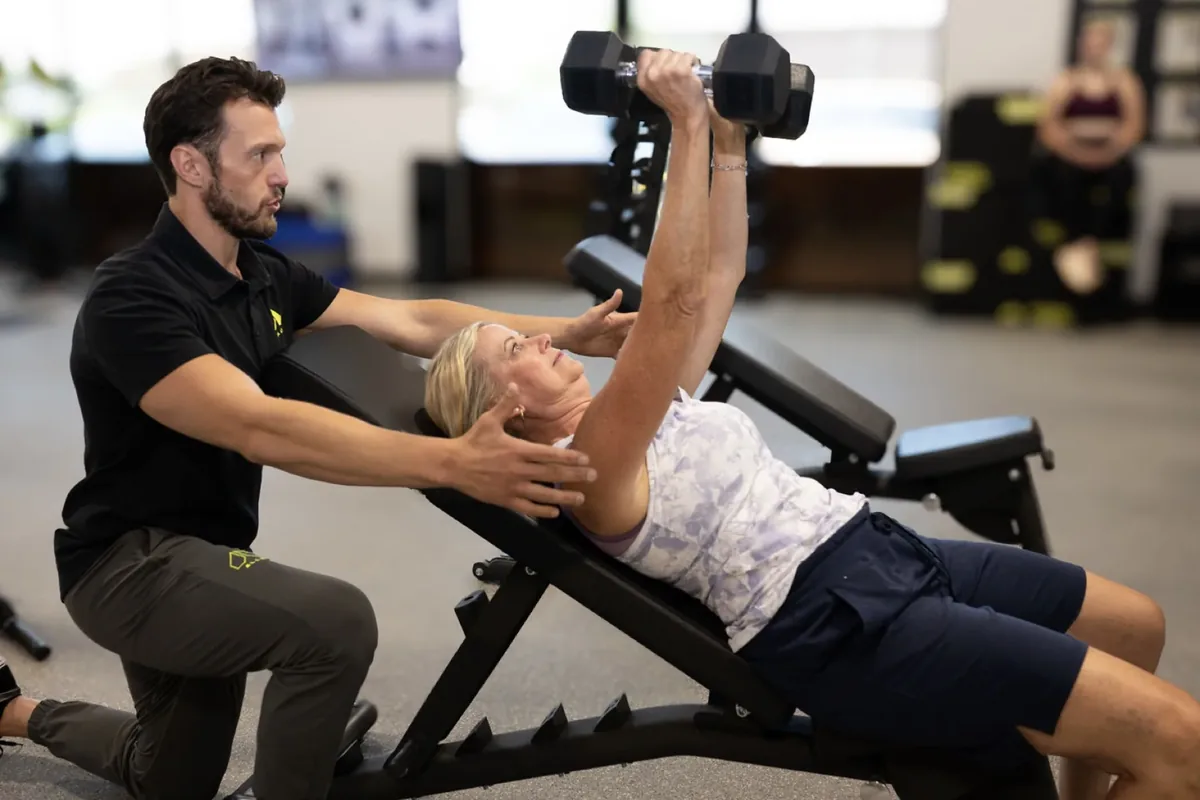
- Two strength sessions on non-consecutive days, covering all major muscle groups at moderate or greater intensity
- A balance component worked into those strength days if you are 65 or older, per the multicomponent recommendation
- Walking days stay walking days. Strength sessions are added to the week, not swapped in for your trail time
Two sessions is the number in the guideline, not a starting compromise. It is also about 100 minutes a week, which is less time than most people spend walking in a good weekend.
How the Strength Half Gets Programmed
The reason most walkers never add strength work is not stubbornness. It is that the second half of the guideline comes with real questions: which movements, how much load, what to do about a knee that complains, how to progress without getting hurt. Those questions have answers, but they are not the kind you can look up once and be done with.
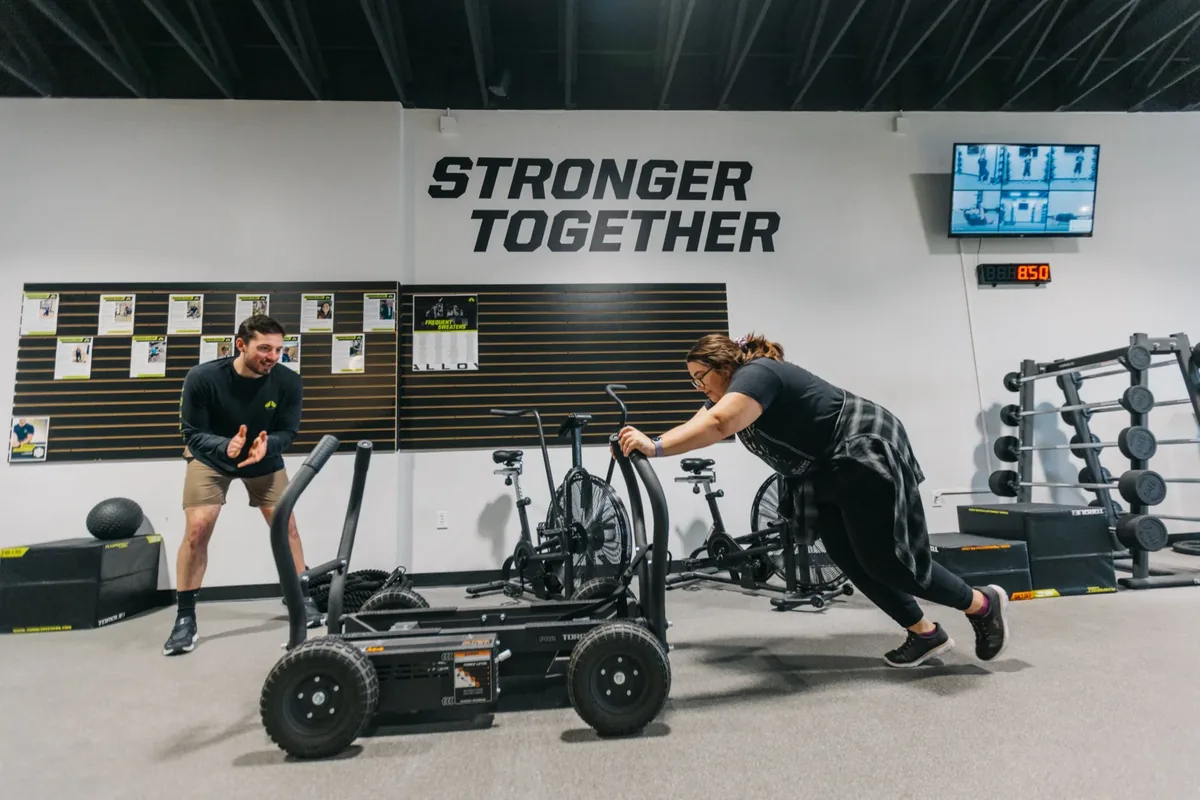
Our small group personal training sessions at Alloy Personal Training Cary run 50 minutes, are coach-led from start to finish, and are capped at six members, so every workout is individualized to your body, your goals, and your injury history. Membership includes a functional movement assessment, monthly InBody body-composition scans, ongoing nutrition coaching, and monthly accountability sessions. Members join a coaching relationship rather than a room full of equipment, which is the part that makes two days a week actually happen. You can read more about how we coach or about small group training in Cary.
Most members notice improvements in energy, strength, and confidence within the first few weeks. Body-composition change typically shows up over 8 to 12 weeks, which is what the monthly scans are for. Long-term results come from consistency, the same way your walking habit got built.
Add the Second Half
If you already walk, you have done the part most people never start. The next step is small: two structured strength sessions a week, built around what your body can actually do right now. The complimentary Starting Point Session covers a strength and mobility assessment, an InBody scan, a goal-setting conversation, and a customized plan, with no obligations attached. Our studio is at Alston Town Center off NC-55 in west Cary, minutes from the greenways you are already using, and members have rated us 5.0 stars across 35 Google reviews since we opened in 2025. Book your complimentary Starting Point Session when you are ready to fill in the other half of the guideline.